

Understanding UTUC
UTUC Defined
UTUC is not “kidney cancer” in the way most people understand it.
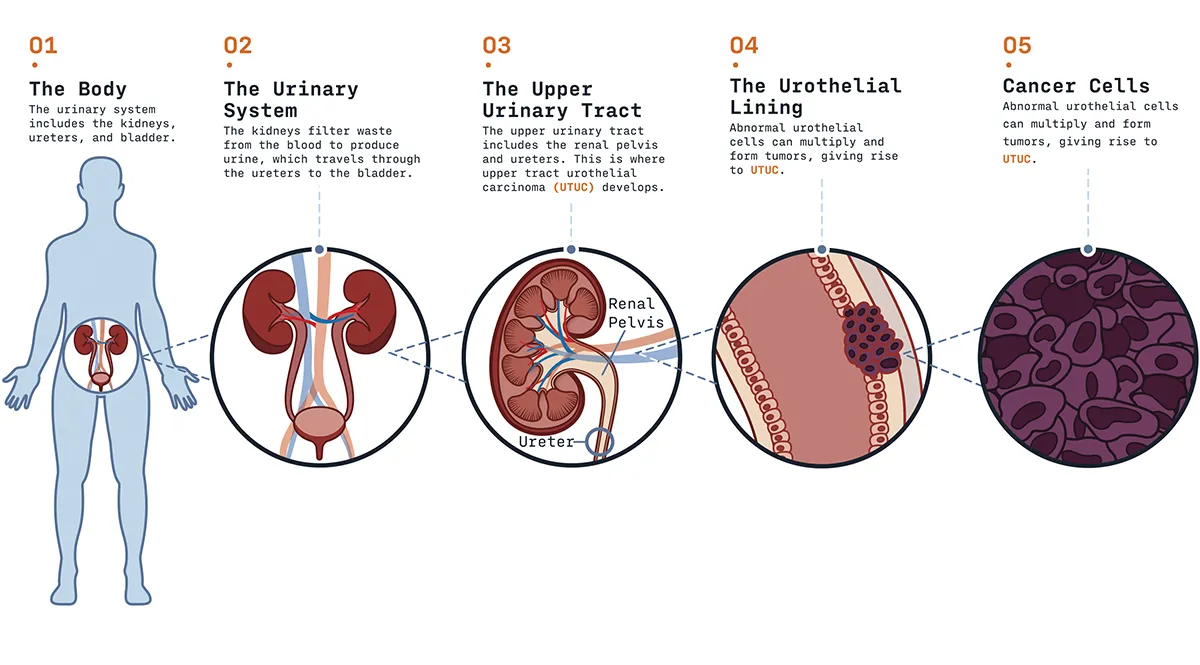
Upper tract urothelial carcinoma (UTUC) is a cancer of the urothelium, the tissue lining the urinary tract, in the renal pelvis (where urine collects inside the kidney) and the ureter (the tube carrying urine to the bladder).
UTUC shares an organ with kidney cancer but not its biology; it shares its biology with bladder cancer but not its anatomy or tumor behavior. The result is a cancer neither field fully covers: kidney research doesn’t apply, and bladder research doesn’t reliably translate.
Risk Factors
The exact cause of UTUC in any individual patient is often not identifiable. But several factors are known to increase risk:
- smoking: The single largest modifiable risk factor for UTUC.
- Lynch syndrome: An inherited genetic condition that impairs the body’s ability to repair DNA, raising the risk of UTUC.
- Chronic Inflammation, Infection, or Stones: Long-standing irritation of the urothelial lining elevates the risk.
- Personal History of Bladder Cancer: The bladder and upper tract share the same lining, so prior bladder cancer increases the risk of UTUC.
Diagnosis
UTUC is diagnosed through a combination of imaging, urine testing, and a scope procedure but confirming the stage is uniquely difficult.
UTUC is typically identified through a combination of tests. A CT urogram, a scan that uses contrast dye, creates detailed images of the kidneys and ureters, and a urine test checks for cancer cells. Diagnosis is often confirmed with an ureteroscopy: a procedure in which a thin, flexible scope is passed through the bladder into the upper tract to directly visualize the tumor and take a small sample, called a biopsy.
Diagnosing UTUC accurately is difficult, largely because of anatomy: the ureters and renal pelvis are narrow, which limits the size of tissue samples that can safely be obtained. Because these samples frequently don’t show how deeply the tumor has invaded, the stage is often unknown until the surgical specimen is examined.
Staging
Stage guides how aggressively UTUC is treated, but it often can’t be determined accurately until after surgery.
Like most cancers, UTUC is described by stage—how deeply the tumor has invaded and whether it has spread—and by grade, how aggressive the cells look. Together they guide treatment: low-stage, low-grade disease may call for surveillance or organ-sparing options, while higher-stage or high-grade disease pushes toward surgery and systemic therapy.
The difficulty is that this system was borrowed from bladder cancer, where a tumor can be seen and sampled directly. In the upper tract it often can’t be, so the depth of invasion that drives treatment decisions is frequently unknown pre-surgery. That gap leaves patients at risk of being overtreated, undergoing more extensive surgery or therapy than they needed, or undertreated, receiving less than their cancer required.
Improving the accuracy of pre-surgical staging, through better imaging, molecular testing, and other tools, is one of the most active areas of UTUC research today.
Treatments
Treatment for UTUC depends heavily on the cancer’s stage, grade, and location and often involves more than one of the approaches below.
The decision to remove a kidney or spare it has consequences beyond the surgery: it can narrow a patient’s chemotherapy options later.
Nephroureterectomy: Removal of the entire kidney, the ureter, and a small piece of the bladder. This is the standard treatment for high-risk UTUC. It is effective, but permanently reduces kidney function.
Ureteroscopy with laser ablation: A thin scope is passed through the bladder into the ureter and renal pelvis to view and treat the tumor with a laser. For select patients with small, low-grade tumors, it offers a kidney-sparing alternative to full removal.
Chemotherapy may be given before surgery (neoadjuvant) or after (adjuvant), depending on the patient and the timing of treatment.
Platinum-based chemotherapy (cisplatin, carboplatin): The standard for urothelial cancers, used in high-risk UTUC to treat cancer that may have spread beyond what surgery removes. Cisplatin is more effective but harder on the kidneys, so carboplatin is often used when kidney function is reduced, as it often is after surgery.
Jelmyto® (mitomycin gel): A chemotherapy approved for low-grade UTUC. This reverse-thermal gel—liquid when cool, semi-solid at body temperature—is delivered through a catheter to coat the upper urinary tract, offering a kidney-sparing option for select patients.
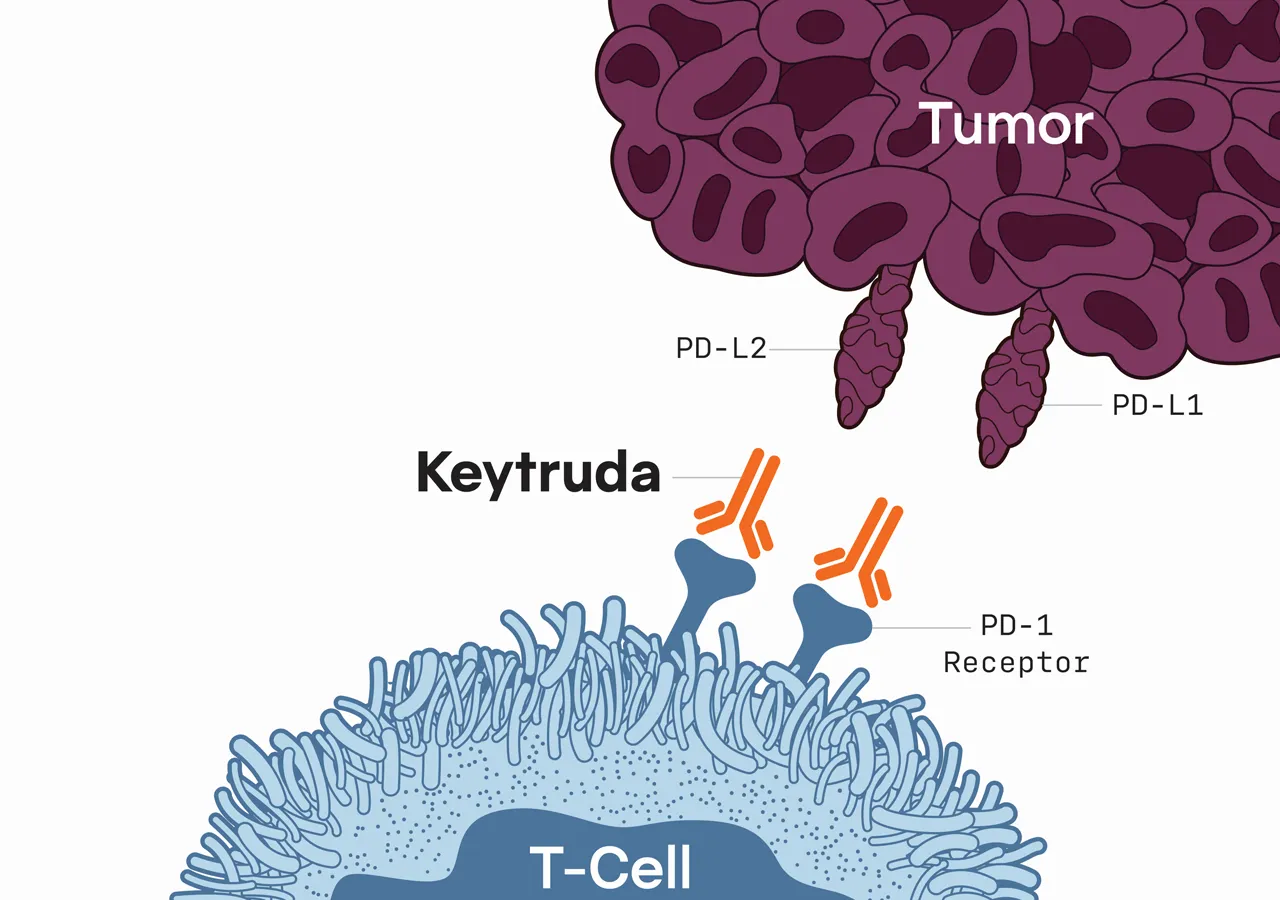
Immunotherapy helps the immune system recognize and attack cancer. In UTUC, the main drugs block a protein called PD-1.
Nivolumab (Opdivo®): A PD-1 blocker, FDA-approved as therapy after surgery for high-risk muscle-invasive urothelial cancer, an approval that technically includes UTUC, though the evidence comes overwhelmingly from bladder cancer.
Pembrolizumab (Keytruda®): A PD-1 blocker used for advanced urothelial cancer. It can be given on its own for patients who can’t receive platinum chemotherapy or in combination with enfortumab vedotin (see Targeted Therapy)
Targeted therapies are drugs designed to act on specific proteins or genetic features of cancer cells, rather than attacking all fast-dividing cells the way chemotherapy does.
Enfortumab vedotin (Padcev®): An antibody-drug conjugate that seeks out Nectin-4, a protein on the surface of most urothelial cancer cells, and delivers chemotherapy directly to those cells. Used for advanced UC, on its own after other treatments or combined with pembrolizumab as a first-line option.
Erdafitinib (Balversa®): A targeted oral drug that blocks FGFR. It’s FDA-approved for advanced urothelial cancer, including UTUC, in patients whose tumors carry FGFR2 or FGFR3 alterations. Because these alterations are more common in the upper tract than the bladder, more UTUC patients are candidates for it.
Life After Nephrectomy
Kidney function declines after surgery, and because some chemotherapies require adequate kidney function, this decline can narrow the treatment options available if the cancer returns. But long-term studies are reassuring: living with one kidney does not raise the risk of kidney failure compared with kidney-sparing surgery. Most people live well with one kidney—it just takes ongoing attention and partnership with your care team.
Recurrence & Surveillance
Recurrence is a real concern after UTUC treatment, and it can happen in three places: the bladder, the upper tract (the remaining kidney and ureter), or elsewhere in the body. Bladder recurrence is the most common.
Current Monitoring
Standard surveillance includes cystoscopy (a camera examination of the bladder) every three months after surgery, along with periodic imaging of the upper tract. This schedule is frequent and, in the case of cystoscopy, invasive.
Where the Science is Headed
ctDNA monitoring: Blood tests that detect circulating tumor DNA, fragments of cancer DNA in the bloodstream, can catch signs of disease before it appears on scans. Developed largely in bladder cancer, this approach is now being tested in UTUC.
utDNA Monitoring: The same idea applied to urine rather than blood. Because urine is in direct contact with the urinary tract, it can capture more of the tumor’s genetic signal—which could offer UTUC patients a less invasive alternative to frequent cystoscopies.